Published: May 14, 2021 | updated: March 03, 2026
Luke is the Head of Marketing at Sandfield with 10+ years of experience in Tech Marketing.
Customer Story

Published: May 14, 2021 | updated: March 03, 2026
Luke is the Head of Marketing at Sandfield with 10+ years of experience in Tech Marketing.
Quick summary
|
The Challenge |
COVID-19 caused "panic buying" surges that put unprecedented pressure on Foodstuffs' systems. Legacy ERPs were too inflexible to relay vital data fast enough, risking empty shelves or massive stock imbalances during peak volatility. |
|
The Solution |
A fully-managed EDI integration engine (Crossfire) powering the new Foodstuffs eXchange system, designed to unlock data from monolithic systems and provide a "single source of truth." |
|
The Result |
Sustained performance during 50k+ messages/hour peaks (nearly a full normal day’s volume in 60 minutes); zero system crashes or failed POs; and the ability to proactively smooth document flows to prevent downstream system overloads. |
And how it helped Foodstuffs process record-breaking order volumes
Back in March 2020, COVID-19 panic set in. Would there be enough food on the shelves, how would vital medical supplies make it across the world? Where would we find flour to bake another much-needed sourdough loaf?
Critically, the pandemic highlighted how fragile our supply chains are in the face of unexpected disruptions.
Some spluttered and some thrived.
And one defining feature of those that thrived was how efficiently systems communicated; how efficiently their data flowed.
You see, many companies hit snags because they couldn’t relay vital supply chain information – like invoices, purchase orders, and inventory – from their systems to suppliers fast enough.
This was often because data was trapped in large, inflexible systems. The monolithic nature of corporate ERP systems impeded companies’ from extracting data and gaining much-needed visibility over their supply chain, which slowed decision making and response speed.
Conversely, companies that invested in free-flowing data and automated processes before the pandemic are tipped to respond better to its disruptions.
The reason being, they had information at their fingertips within minutes of disruption. With early visibility over which suppliers, sites, parts, and products were at risk and where bottlenecks might arise, they could put themselves first in line to secure limited inventory.
This is exactly the kind of free-flowing information we’ve built into Foodstuffs’ new eXchange system through EDI integration. And we saw just how powerful it was in sustaining a resilient supply chain during the pandemic.
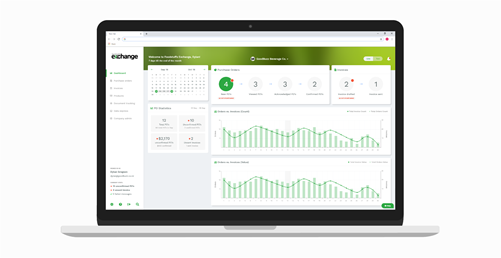
When Foodstuffs kicked off its eXchange system reboot last year – to accommodate a growing volume of suppliers, invoices, and product orders – they couldn’t have predicted just how timely it was.
For a system that transmits between 60,000 and 100,000 messages with suppliers every day and relays more than 73 million transactions a year, the eXchange’s performance is critical. One inaccurate number is the difference between no food on supermarket shelves, or a huge expense in excess stock.
And EDI integration was an indispensable cog in the new eXchange’s operations, as 80% of the data it parses are EDI messages.
Crucially, this integration meant one simple source of data and truth for the entire Foodstuffs team.
“We know that good integration means good information, and when business systems can fluently talk to each other, business value increases.” - Ana Connor, Master Data Operations, Foodstuffs South Island
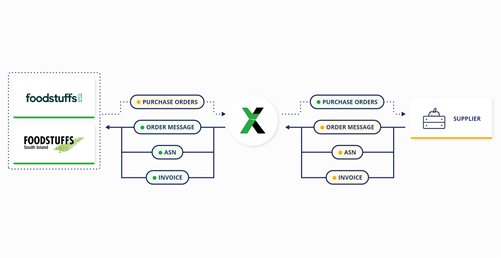
So while Sandfield built a flexible new eXchange portal for suppliers, Crossfire unlocked data from other systems so it could freely flow in and out of the new eXchange. Here’s how it looked:
Then, between Christmas and COVID, a massive surge in shopping volumes put Foodstuffs’ new eXchange to the test. At peak times the eXchange was processing 50,000+ messages per hour (usual trading periods see about 80,000 messages per day).
But the system held strong. And it was Crossfire’s behind-the-scenes work that ensured a smooth flow of accurate data kept systems communicating.
As a fully managed service, the Crossfire team closely monitored throughput and performance to ensure optimal operation. Knowing that Foodstuffs’ eXchange volumes peak at 8am, putting pressure on downstream systems, Crossfire could alleviate that pressure by prioritising and smoothing the flow of documents to systems that couldn’t handle peak volumes.
“Despite rising volumes, no one was talking about the systems crashing or purchase orders not going through. As a business process owner, I was really proud of that.”
- Chris Monkton, Purchasing Process Owner, Foodstuffs North Island
Importantly, the new and robust eXchange remains flexible for further integration and added features.
"This will allow us to be nimbler and more responsive to technological advancements, ensuring we remain well-placed to deliver the best trading experience..”
- Ana Connor, Master Data Operations, Foodstuffs South Island
Yes. Our platform is built to manage enterprise-scale data volumes without compromising performance. For Foodstuffs, we process between 60,000 and 100,000 messages daily—scaling up to 50,000+ messages per hour during peak times—ensuring zero system crashes even during extreme demand surges like the COVID-19 pandemic.
We implement intelligent throughput management to "smooth" the flow of data into your ERP or business systems. For Foodstuffs, we control the rate at which EDI messages are delivered, preventing their internal systems from being overwhelmed by sudden spikes in order volume while ensuring every transaction is processed accurately and on time.
Yes. We specialise in modernising legacy exchange systems to streamline supplier connectivity. For Foodstuffs, we facilitated the transition from their legacy system to a modern eXchange portal, enabling seamless onboarding for their vast network of suppliers and ensuring resilient supply chain operations across the entire cooperative.




© Copyright 2026 Sandfield Associates Limited. All Rights Reserved. Terms of Use | Privacy Policy