Published: May 17, 2021 | updated: March 03, 2026
Luke is the Head of Marketing at Sandfield with 10+ years of experience in Tech Marketing.
Customer Story

Published: May 17, 2021 | updated: March 03, 2026
Luke is the Head of Marketing at Sandfield with 10+ years of experience in Tech Marketing.
Quick summary
|
The Challenge |
As a made-to-order business, The Pillow Collection struggled to report "finished good" stock levels to US retailers based on raw fabric rolls. They also needed to filter specific SKUs from large orders and generate retailer-compliant packing slips manually. |
|
The Solution |
A fully-managed EDI integration with Unleashed featuring custom logic to calculate available stock from raw materials, a SKU "white-list" filter, and automated packing slip generation. |
|
The Result |
Eliminated the risk of overselling/underselling; automated daily stock reports for online stores; removed manual SKU filtering; and ensured 100% compliance with strict US retail shipping standards. |
Five years ago The Pillow Collection decided on Crossfire to manage an introduction with two of their trading partners. The Pillow Collection have been stoked with how things are going.
The Pillow Collection sell high-end pillows to a range of customers, including two major US retailers, let’s call them Retailer ‘X’ and Retailer ‘Z’. The Pillow Collection use Unleashed to manage their inventory.
Both retailers required The Pillow Collection to have EDI set up in order to trade with them. The Pillow Collection approached Crossfire to implement a fully managed, end-to-end EDI solution for both retailers, to help streamline their processes and decrease a portion of manual data entry.
During the scoping phase of the project, when Crossfire began asking questions about The Pillow Collections business, they became aware that there was more involved than simply passing data between Unleashed and each of the retailers to meet the retailer’s strict EDI requirements. We have outlined some of these challenges below.
Every retailer uses different EDI formats (such as adaptations of X12 and EDIFACT), message standards (typically orders, ASN’s and Invoices) and processes for implementing an EDI solution with each of their vendors. For example, Retailer X, requires a ‘Daily Stock Count’ from each vendor, for each individual product that is sold through their online store.
The Pillow Collection doesn’t sell its products ready-made. Instead, to minimize the chances of overproducing and underselling, the Pillow Collections products are made-to-order, which means that they have rolls of material in their warehouse instead of end products ready to be picked. A further challenge was that they have multiple SKU’s that use the same pattern/material, in this case, each SKU represents a different size. When The Pillow Collection initially engaged with Crossfire they didn’t have a solution in mind that would accurately relay the quantities on hand to Retailer X.
Another challenge for The Pillow Collection was that they don’t sell their entire range to Retailer X. Without a solution in place, if orders came through from the retailer with a SKU that the Pillow collection didn’t want to sell to them, it would be an issue. With such a large range of SKU’s, it would have been a manual process for The Pillow Collection to filter these, as they’d have to check each order line to make sure that only SKU’s they wanted to sell to Retailer X flowed through.
Lastly, The Pillow Collection were required to include packing slips for each carton within an order, that met the retailer’s specifications. Before engaging with Crossfire, The Pillow Collection didn’t have a solution for this.
Unable to provide an accurate stock count may have meant that The Pillow Collection either overestimated or underestimated stock on hand or would have instead have to manually calculate how much stock they had at the end of each day.
In this case, If The Pillow Collection had overestimated and undersupplied their products, this would have undeniably lead to a sour relationship, as the retailer would have had to deal with customers that either;
a. Wouldn't receive their order.
b. Would at the very least experience a delay in receiving it.
On the flip side, underestimating how much stock The Pillow Collection had on hand may have meant that they missed out on sales, as once an item showed as ‘out of stock’ on Retailer X’s web store, even though The Pillow Collection would have had the stock to sell, they wouldn’t have been able to.
Lastly, allowing SKU’s that they didn’t want to sell to Retailer X to flow through, would have resulted in headaches with trying to organize stock to be sent back to The Pillow Collection, and without Crossfire it would have required manual checks to stop this from happening.
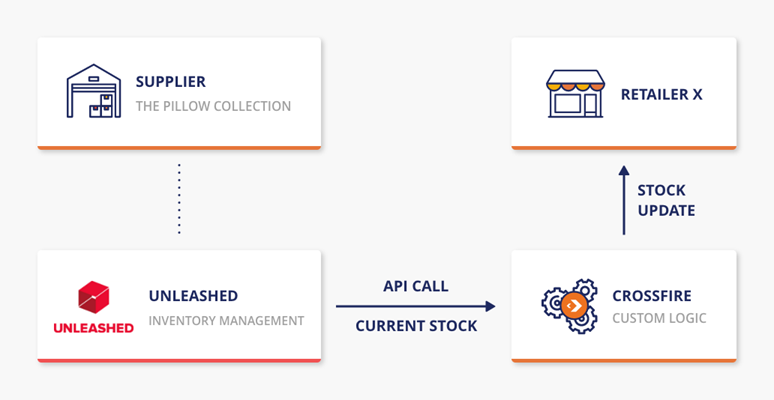
Crossfire installed custom logic that now works out the quantities that The Pillow Collection can provide the retailer. A stock report is automatically generated from The Pillow Collections Unleashed inventory management system to pass through Crossfire and is then converted into the retailer’s format. Based on how much fabric The Pillow Collection has at any given time, Crossfires formula works out how many pillows can be made in across different sizes and therefore provides a more accurate idea of stock on hand. Part of this formula automatically reduces the quantities for other SKU’s that use the same pattern when orders come through for other sizes.
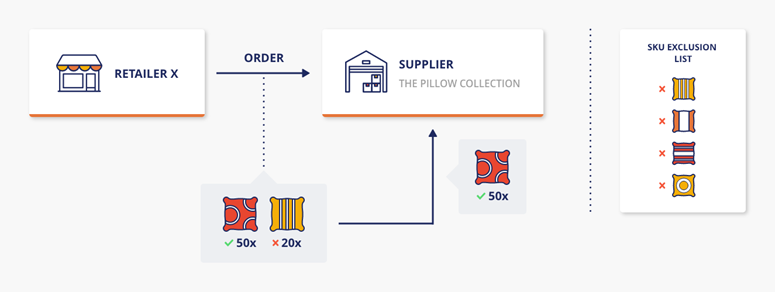
To ensure only SKU’s that The Pillow Collection want to sell through the retailer’s online store fed through to the retailer, Crossfire developed a white-list template and implemented logic to support this in Crossfire. When a new season comes around, The Pillow Collection sends through a list of SKU’s they have agreed to sell to Retailer X, which is automatically uploaded into the Crossfire system. This restricts what SKU’s pass-through, ensuring that unwanted SKU’s are filtered and an error message notifies the appropriate party if an unwanted SKU comes through.
Lastly, to assist in making this process streamlined for The Pillow Collection, Crossfire developed a packing slip that met the retailer’s requirements. A process was then established which automatically triggers the packing slip to flow through to a designated folder that The Pillow Collection have access to. The warehouse team can then print these and physically attach them to each order.
Yes. We manage the specific EDI standards and compliance requirements for retailers across the US. The Pillow Collection relies on our platform to trade seamlessly with multiple US-based retailers, handling all the technical formatting and message standards automatically so they can focus on sales rather than compliance.
Our solution is designed to remove manual data entry entirely by automating the transfer of information. Before partnering with us, The Pillow Collection faced significant risks of error from manual order filtering and entry. We automated these workflows, ensuring 100% data accuracy and significantly reducing administrative time.




© Copyright 2026 Sandfield Associates Limited. All Rights Reserved. Terms of Use | Privacy Policy