


By Henry Payne
Published: October 12, 2026 | updated: October 19, 2026
Henry is the Head of Crossfire, Sandfield’s integration specialist unit, with 20+ years of experience in data and system integrations.
Insights + Blogs

By Henry Payne
Published: October 12, 2026 | updated: October 19, 2026
Henry is the Head of Crossfire, Sandfield’s integration specialist unit, with 20+ years of experience in data and system integrations.
Most integration teams can build a new connection without much trouble. The harder job is finding, understanding and safely changing one of the hundreds they already run, and that job usually depends on who happens to remember building it.
Ask an integration team how a particular customer's setup works and you will often get the same answer: "Ask Sarah, she built it." That works fine until Sarah is on leave, flat out on something else, or has moved on, at which point a simple question from a customer turns into an afternoon of digging.
An IT leader at a logistics business put it to us plainly during a recent demo. On their current platform, he said, "the only reason they know is because they remember doing it." New starters can't pick it up, because the knowledge was never written anywhere they could find it.
That’s where Crossfire AI comes in. Rather than relying on tribal knowledge, messy spreadsheets, or manual mapping, Crossfire AI builds and tests complex integrations from sample files and generates plain-English documentation directly from your workflows in seconds. It gives your entire team immediate visibility into how any customer's setup works, letting anyone search, understand, and safely modify integrations without needing to read complex code or rely on the single person who originally built them.
Nobody sets out to build integrations that only two people understand. It happens one reasonable decision at a time.
Take a third-party logistics provider. A typical warehousing customer needs a handful of core messages: inbound shipments and confirmations, outbound shipments and confirmations, products, inventory adjustments and billing, often with a stack of acknowledgements on top. That part is predictable, and most teams have it well under control.
Then the business rules arrive. One customer does repacks, another builds finished products from a bill of materials, and a third needs a completely different message whenever a particular value turns up in a particular field. Each rule is small and makes sense when it's added, but each one adds a workflow or a step. Spread that across hundreds of customers and you end up with thousands of workflows, each slightly bespoke, most built by hand, and documented (if at all) in a spreadsheet that was accurate on the day someone wrote it.
Integration vendors, us included, like to talk about how fast you can build. In our experience the first build is rarely what hurts your team. The cost turns up later, every time someone has to find the right workflow when a customer calls, work out what it does before touching it, change it without breaking the one next to it, or explain it to a colleague who wasn't there when it was built.
Here's a real example of the kind of question that lands on an integration team. A customer wants to know why they were sent a single can when they ordered a box. The answer is a pack-level rule somewhere in that customer's mapping, and someone has to find which workflow, which step and which rule. If the file is X12 and the person on shift can't read X12, the question waits for the one person who can.
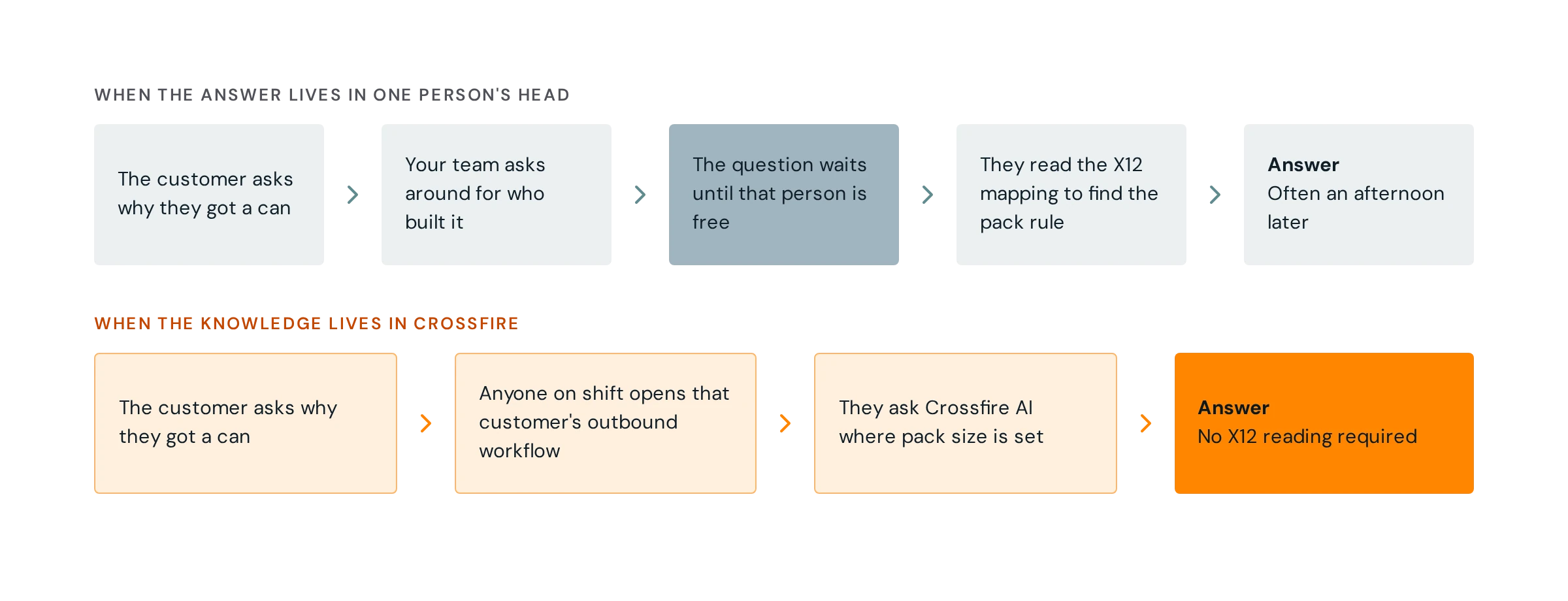
That's key-person risk, and it costs more than people tend to admit. Customers wait longer for answers, new staff take a long time to get up to speed, and the platform gets harder to move off every year because the knowledge you would need to move it sits in people's heads. A platform only two people understand costs a lot more than its licence fee suggests, even when the licence is cheap.
Three things need to be true before you stop depending on memory.
The first is that anyone on your team can find the right integration quickly. In Crossfire you search across all your integrations and filter down until you're looking at the exact customer, workflow and step you need, rather than scrolling through a list of hundreds or asking around.
The second is that they can understand it without reading code. You can ask Crossfire AI to write up how any integration works, in plain English, and it produces that documentation in seconds from the integration itself instead of from someone's recollection or a wiki page nobody has kept up to date. For the can-and-box question, that means opening the customer's outbound workflow and asking where pack size is set, which anyone on the team can do whether or not they read X12.
The third is that changes are safe to make. Every change in Crossfire is versioned, so you can see what changed and when, and roll back straight away if something goes wrong.
None of this removes the need for people who know your business. Someone still has to understand why that customer wants boxes and not cans, and that kind of judgement is exactly what your integration people are good at. What changes is that their knowledge lives in the platform where the whole team can reach it, so they spend less time being the only map to their own work and more time with your customers.
Could anyone in your team explain how an integration works within 5 minutes, or confidently make changes to an existing integration? This is a utopia that we all aspire to, Crossfire included, but we're on a track to get to that utopia using immediate AI based explanations of integrations in real time and it’s a far better solution than having valuable documentation we spend countless hours keeping up to date.











© Copyright 2026 Sandfield Associates Limited. All Rights Reserved. Terms of Use | Privacy Policy

