By Henry Payne
Published: October 07, 2026 | updated: October 08, 2026
Henry is the Head of Crossfire, Sandfield’s integration specialist unit, with 20+ years of experience in data and system integrations.
Insights + Blogs

By Henry Payne
Published: October 07, 2026 | updated: October 08, 2026
Henry is the Head of Crossfire, Sandfield’s integration specialist unit, with 20+ years of experience in data and system integrations.
AI-native integration in the context of B2B, EDI, and API integration is where artificial intelligence autonomously builds, tests, and refines data mappings from sample files. Unlike traditional or AI-assisted integration tools, an AI-native system writes inspectable translation code, executes system tests, and iterates until validation passes, leaving humans to answer business rules rather than code line by line.
Having managed EDI and API integrations for over 20 years at Crossfire, we recently rebuilt our engine and user interface from the ground up around this exact capability. We didn't do it just to add a flashy chatbot sidecar to an existing portal. We realised that AI could create a fundamental shift in who does the build work. Rebuilding around an AI mapping agent turned Crossfire into a truly AI-native integration platform.
Most integration platforms now claim AI makes things easier. But the label on its own tells you very little. To evaluate any platform, the useful question is simple: who does the mapping work, and how do you know it's right?
AI-native integration means the core integration engine and capabilities is architected around AI at its core. In an AI-native setup, the AI does the actual build work itself. Rather than a developer manually mapping fields line by line, the AI agent reads raw sample files, infers the translation rules, writes inspectable mapping logic, runs system tests, and iterates until those tests pass.
Every message a business exchanges with its trading partners passes through an integration somewhere, whether it’s an ERP’s EDI message, a carrier’s API, or a CSV file dropped on an SFTP server.
Building those connections used to take days or weeks of manual coding. Rebuilding an engine around AI changes who does that heavy lifting.
AI shows up in iPaaS and EDI middleware in three broad ways, and they are easy to confuse in a sales demo:
|
Kind |
What the AI does |
Who does the mapping |
How you know it's right
|
|---|---|---|---|
|
AI assistant |
Answers questions about the product or documentation. |
A developer, by hand. |
The developer's own manual testing. |
|
AI-assisted mapping |
Suggests field matches to accept or reject field by field. |
A developer, reviewing line by line. |
The developer's own manual testing. |
|
AI-native integration (Crossfire) |
Infers rules from sample files, writes code, and iterates on tests. |
The AI, with a person answering business rules. |
Automated tests before anything goes live, with full versioning. |
The first two save a bit of time at the edges. The third actually changes who does the work. That is why we chose to rebuild the platform rather than just adding an "AI-enabled" feature onto legacy architecture.
Why the engine around the AI matters: Plenty of developers already paste two sample files into ChatGPT and get a decent mapping snippet back. What general AI tools lack is an enterprise engine: a secure place to test that code against real payloads, publish it safely, monitor it 24/7, and update it six months later without breaking production.
When we designed the new Crossfire AI interface and engine, we built the workflow around an automated loop:
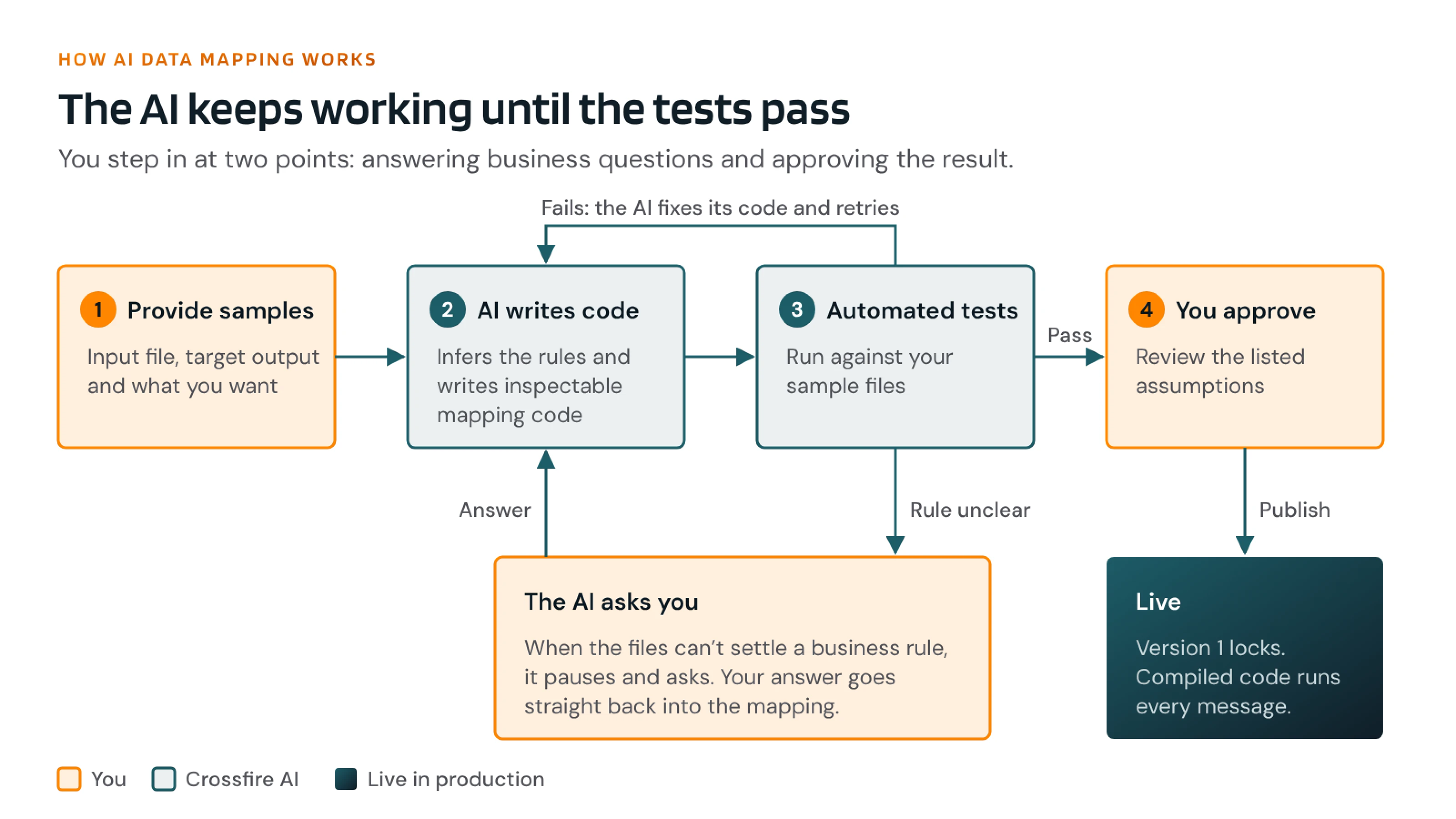
The human role shifts from tedious manual coding to two high-value checkpoints: answering business questions that files can't settle, and giving final approval before going live.
Say a freight forwarder is onboarding a new shipper:
In the new Crossfire interface, the forwarder uploads sample files. The AI agent maps consignee, container type, cargo, and weights, then runs system tests.
It then pauses on three operational questions the files can't answer:
Answering these requires someone who understands the forwarder's business operations, not someone who reads XML. Once those rules are confirmed, the tests pass, and the forwarder publishes the integration.
If you are evaluating an iPaaS or B2B integration platform, these questions separate a true AI-native engine from a demo. For each question we have indicated Crossfire AI’s approach:
There is plenty of talk about AI agents replacing integration engines altogether by calling APIs dynamically or communicating agent-to-agent at runtime. While interesting, this approach isn't built for thousands of routine B2B transactions a day.
Running an AI model on every single incoming message takes seconds where compiled code takes milliseconds, and it introduces cost per message. More importantly, AI models are probabilistic, whereas trading partner rules and reconciled invoices need the exact same input to yield the exact same output every time.
That is why the new Crossfire AI platform uses AI to write the integration, not to be the integration. The agent writes and tests the code once; that compiled code then processes every message cleanly without calling an AI model. Runtime AI earns its keep only where inputs are messy such as a purchase order arriving as a PDF.
The benefits
The honest limit
Mapping is only one part of partner onboarding. The longer stages are agreeing on business rules with the trading partner and carrying out end-to-end testing together. AI accelerates technical setup significantly by raising rule questions early from sample files, but those human conversations still take time.
In AI-assisted integration, a developer manually builds the mapping while AI suggests fields or answers questions. In AI-native integration, the AI builds and tests the mapping code itself from sample files, while a human provides business guidance and final approval.
Not quite. Agentic integration usually means AI agents handling live exchanges dynamically at runtime. AI-native integration uses AI to design, write, and test compiled code during the build phase, keeping runtime processing fast, deterministic, and cost-effective.
Yes. The AI takes over reading complex formats and writing mapping logic. People are still needed to work out partner requirements, answer operational questions, and decide when an integration is ready to launch.
The mapping itself takes minutes and varies based on complexity. The overall project timeline still depends on how quickly both parties agree on business rules and complete testing.
Crossfire’s AI agent parses standard EDI formats (like EDIFACT, X12, and IDoc) alongside custom XML, JSON, CSV, and fixed-width layouts. By reading raw sample payloads rather than relying on strict, rigid templates, the agent infers mapping logic across custom schemas and generates compiled, inspectable code that runs natively within the Crossfire engine.
Yes. Crossfire’s AI agent is sandboxed per integration, ensuring your data and mapping rules are never shared across environments or used to train public models. The platform operates under strict least-privilege access controls, protected by disk, database, and executable guardrails, and is operated by Sandfield under ISO 27001 certification.



© Copyright 2026 Sandfield Associates Limited. All Rights Reserved. Terms of Use | Privacy Policy