By Henry Payne
Published: October 06, 2022 | updated: March 03, 2026
Henry is the Head of Crossfire, Sandfield’s integration specialist unit, with 20+ years of experience in data and system integrations.
Insights + Blogs

By Henry Payne
Published: October 06, 2022 | updated: March 03, 2026
Henry is the Head of Crossfire, Sandfield’s integration specialist unit, with 20+ years of experience in data and system integrations.
Key insights:
Standardised framework: Peppol is an international network that standardises how electronic documents (like e-invoices) are formatted and securely transmitted.
Economic impact: Adoption is estimated to save New Zealand and Australian businesses $30 billion over 10 years by reducing manual processing and errors.
Government incentives: Both the NZ and Australian governments are driving adoption by offering faster payment terms (5–10 days) for e-invoiced transactions.
Secure transmission: Unlike other standards, Peppol defines the transmission method through registered Access Points, ensuring high security and credibility.
Another year, another message standard that’s meant to change the world, simplify integration and be adopted by everyone. We’ve seen EDIFACT, X12, UBL, TRADACOM, UBL 2.0, GS1, and many more over the years, some have been successful and widely adopted, some have not.
The latest one is Pan-European Public Procurement On-Line or PEPPOL for short, and it’s a little different.
It’s already well established in Europe, it has recently been adopted in Australia, and now it’s in New Zealand. Reports have estimated a saving of $30 billion over 10 years for New Zealand and Australian businesses.
Governments and councils have been embracing it, giving it traction and causing an immediate uptake from their suppliers. The New Zealand and Australian governments aim to offer 10 day and 5 day payment terms respectively for e-invoicing. These things will certainly help it gain adoption.
The difference between PEPPOL and other standards is that PEPPOL also defines the way in which the data is transmitted, not just the file formats. This ensures secure transport. It also requires transmission parties (called Access Points) to be registered with the OpenPEPPOL organisation, which gives them some credibility and helps ensure secure practices are followed.
Right now in New Zealand, PEPPOL is largely about electronic invoicing. With MBIE driving it from the government, and Xero already demonstrating the delivery of PEPPOL invoices, we can see that PEPPOL will be the future of electronic invoicing in New Zealand.
Maybe it will even be the Nirvana of electronic trading that every standard aspires to be. Time will tell.
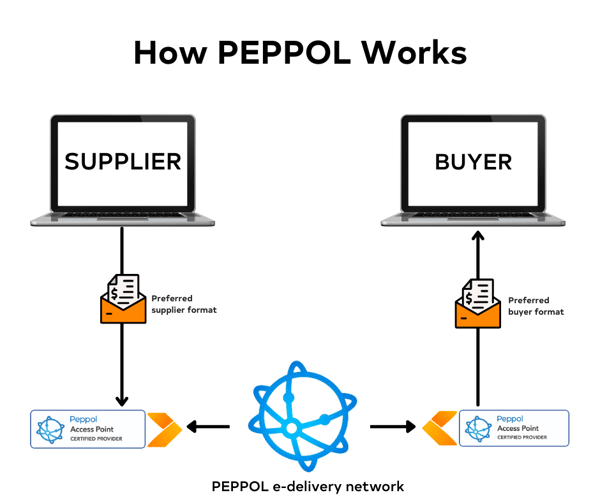
Crossfire has become a registered PEPPOL Service Provider and Access Point.
If you have a number of suppliers that use Xero, by accepting PEPPOL invoices into your system, every one of those suppliers could be doing electronic invoicing overnight.
Feel free to contact us if you would like to know more about PEPPOL.
The primary benefit of Peppol e-invoicing is faster payments and reduced administrative costs. By using a standardised framework, invoices are sent directly from one accounting system to another via registered Access Points, eliminating the need for manual data entry, PDF attachments, or paper. This results in significantly higher accuracy, improved cash flow through government-backed 5–10 day payment terms, and an estimated $20 saving per invoice compared to traditional manual processing.
Unlike other EDI standards (like EDIFACT or X12) that primarily focus on file formats, PEPPOL also defines the specific way data is transmitted. It requires transmission parties, known as Access Points, to be registered with the OpenPEPPOL organisation. This ensures a standardised, secure method for both the format and the transport of business data.
To use PEPPOL, a business needs to connect through a registered Access Point, such as Crossfire. By becoming PEPPOL-enabled, a company can instantly receive electronic invoices from any supplier using a PEPPOL-capable system (like Xero). This allows for "overnight" automation of the invoicing process across a vast network of suppliers and partners.




© Copyright 2026 Sandfield Associates Limited. All Rights Reserved. Terms of Use | Privacy Policy