

Quick summary
|
The challenge |
Muk Mat's EDI bill had climbed to $1,700 a month for a single retail connection, while order volumes stayed flat. The contract with their existing provider ended on a fixed date, and paying two providers at once was off the table. |
|
The solution |
A fully-managed EDI switch, live inside the three months quoted, with no change to the warehouse process. |
|
The result |
Muk Mat now pays less than half the monthly cost for the same order volume, and the crew prefer the portal they work in now. |
Muk Mat makes the plush doormat that keeps sand and dirt out of caravans and homes right across Australia. When the EDI subscription connecting it to Anaconda climbed to $1,700 a month, Head of Finance Emily Whishaw went looking for something better. She found it, and her warehouse team didn't have to learn a new way of working.

What happens when a retailer mandates EDI
Anaconda has stocked Muk Mat's products since the early days and now carries them in hundreds of stores. A couple of years ago it changed its supplier policy: invoicing and shipping data had to move by EDI. Until then, Muk Mat had done it all manually, resulting in additional labour costs and potential for human errors.
It is a common scenario for retail suppliers. A key trading partner shifts to automated document exchange and mandates EDI across its supplier base. It starts as an IT problem with a deadline attached, but handled properly it is one of the better operational upgrades a supplier can make, because automating document exchange takes the whole job off the team, reducing errors and the penalties that come with it.
For most suppliers, EDI is a technical discipline sitting a long way from what the business is actually good at and wants to focus on. Muk Mat makes astroturf doormats. Becoming an in-house expert in message formats and retailer certification was never going to be a good use of time, so it signed with an established managed EDI provider, which promised a quick setup. "Well, they said quickly," Emily says. "Turns out it wasn't quickly." It took about a year to get the connection working properly.
Then the price started climbing, while order volumes weren’t growing as quickly. By the end, Muk Mat paid $1,700 a month to connect to one retailer, which made it "the most expensive subscription we have in the business".
Outsourcing EDI is the right call for a business like Muk Mat, but what you are choosing runs deeper than a feature list. A provider's response times become your response times, their view of your orders becomes your view, and the price they set works in your favour when you pick the right partner. That is what Emily went looking for.
How Muk Mat chose its next EDI provider
Emily runs finance and owns the technical connections to Muk Mat's accounting and inventory systems, so the search landed on her desk. She wanted more transparency, responsiveness and better value for money.
On cost, Crossfire came in well under what Muk Mat was already paying, with a fixed monthly price per connection rather than a bill that crept up each renewal.
On timing, the Crossfire team were transparent about what an integration actually takes, then delivered on it. With a fixed end date on its existing subscription and no budget to pay two vendors simultaneously, Muk Mat had a strict deadline to meet. Emily says the Crossfire team was very clear that an integration takes three to four months, with "no false promises that it would be any faster".
How long an EDI provider switch takes
After initiating the project, the target completion time was 8 weeks. Over a few days, configuring system access and connectivity, the initial weeks focused on properly scoping the work and mapping how Anaconda orders actually move through Muk Mat's systems. Once that was settled, the build moved fast, progressing through user acceptance testing, final sign-off, go-live release, and two weeks of post-launch support. Muk Mat was live as expected before their 60-day notice period ended with the other provider.
With Muk Mat and the Crossfire team both being in the southern hemisphere, questions were answered on the same working day instead of overnight. Emily describes no lag in correspondence in either direction. Compared to a first implementation that took a year, the contrast was hard to miss. "It was chalk and cheese," she says. "So much more organised."
What changed in the warehouse, and what didn't
Muk Mat brought fulfilment back in-house from a 3PL, so its own team picks and packs every Anaconda order. Keeping that running smoothly mattered, which is why the new integration reproduced the existing flow exactly:
- Orders land in the Crossfire Portal and push into Unleashed
- Unleashed syncs with Starshipit
- Shipping and invoice data go back to Anaconda
"It actually flows exactly the same, which was great, because that was the process we were used to. We didn't have to change anything internally. We just have a more effective platform setup."
Emily Whishaw, Head of Finance at Muk Mat
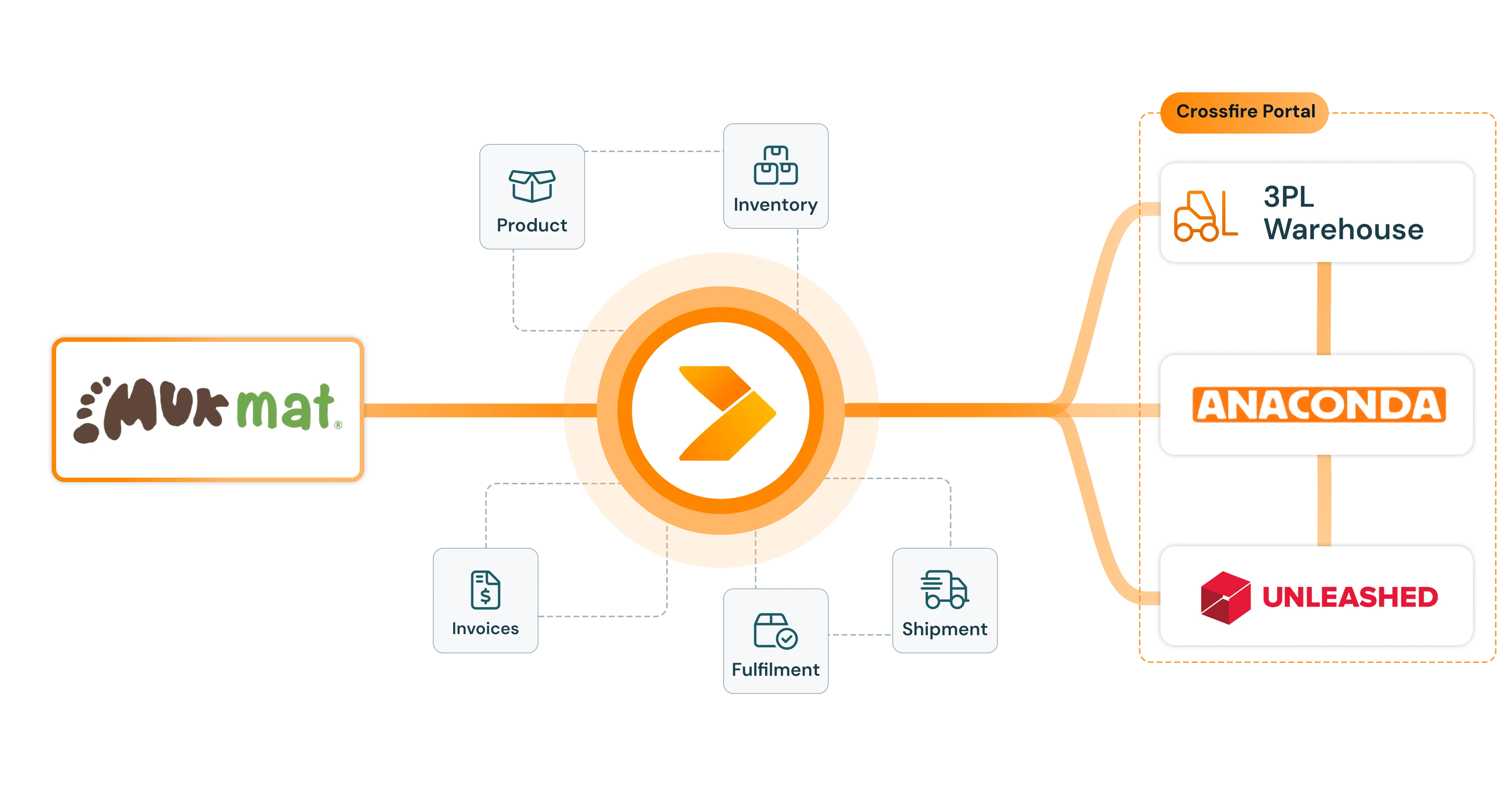
The data flows Crossfire replaced
The core steps stayed the same, but the Crossfire Portal gives real-time visibility of what has moved and what has errored. When an Anaconda order does not look right, the team can see which one and why without chasing it. The warehouse crew process every Anaconda order through the Portal each week and prefer it to the system they used before. Emily rates it "very modern and user friendly", and notes that "sometimes the user experience is forgotten with certain software".
What fully-managed EDI covers after go-live
Plenty of integration projects finish at go-live. A fully-managed service keeps going. For the first fortnight, the Crossfire team monitored the orders and resolved any errors needed to ensure the integration was solid. Questions still get answered quickly.
Under Crossfire Managed, Muk Mat receives complete ongoing assistance, from 24/7 phone and email help to active system monitoring with immediate alerts. Urgent P1 issues are usually addressed within 24 hours, and the service handles API updates, onboarding, and team training. Strong security defences are also included, featuring rapid threat response, penetration testing, and continuous port checks.
What the saving funds next
Muk Mat now pays less than half of that $1,700 a month for the same connection, doing the same volume. Across a year, that saving is what made the business case for the directors. It arrived without a single change to how orders get picked and shipped, and it helps fund the next move.
Muk Mat launched in the US in August 2026 and has already attracted serious retail interest. Those retailers will bring EDI requirements of their own, and Muk Mat can add them through the fully-managed service they trust, Crossfire Managed. Crossfire supports trading partners in more than 30 countries, so a new market means connecting to those US retailers rather than finding another provider.
"If we'd had the power of the crystal ball, we would have just stuck with Crossfire."
Emily Whishaw, Head of Finance at Muk Mat
Sitting on an EDI subscription you cannot justify? Talk to a Crossfire integration consultant about what a switch would look like against your systems, your retailer and your renewal date.
Frequently asked questions
Yes. A switch changes how documents move between you and your retailer, which is invisible to the people picking and packing. Muk Mat's new integration reproduced its existing flow exactly, so orders still land in a portal, push into Unleashed, sync with StarShipIT and send shipping and invoice data back to Anaconda. The warehouse team carried on as before.
No, and it is a common misconception. EDI runs on standardised formats, so as long as your provider translates your data into the format your trading partner expects, you can exchange documents with them regardless of who their provider is.
Because a lot of EDI pricing rises at renewal regardless of what you send through it. For example, Muk Mat's bill reached $1,700 a month for one retail connection, which made it the most expensive subscription in the business. It’s important to understand whether the monthly fee is fixed per connection, and whether there are per-message fees that increase with your volumes.