By Mina Kouch
Published: May 06, 2026 | updated: May 19, 2026
Mina is the Marketing Content Manager at Sandfield, specialising in digital strategy and tech-driven content.
Service model guide

By Mina Kouch
Published: May 06, 2026 | updated: May 19, 2026
Mina is the Marketing Content Manager at Sandfield, specialising in digital strategy and tech-driven content.
EDI (Electronic Data Interchange) is the automated exchange of business documents — such as purchase orders, invoices, and shipping notices — between companies in a standardised format. There are four main ways to deploy EDI: fully-managed, co-managed, iPaaS, and web EDI. They differ fundamentally in who does the work and what technology underpins it. The right approach depends on your transaction volume, internal IT resources, and growth plans.
Businesses implement EDI in four main ways, each representing a different balance between provider responsibility and internal effort:
Fully-managed EDI: An end-to-end service where the provider handles everything — setup, mapping, monitoring, and ongoing maintenance.
Co-managed EDI: A shared model where you and the provider divide operational responsibilities, typically with you managing day-to-day tasks on the provider's platform.
iPaaS (Integration Platform as a Service): A cloud platform category where your internal team builds and maintains integrations using the provider's tools and infrastructure.
Web EDI: A browser-based portal for manually entering EDI transactions — EDI without true automation.
It is worth noting that these four options are not all the same type of thing. Fully-managed and co-managed describe who does the work. iPaaS describes the underlying platform technology. Web EDI describes a specific product with a defined capability ceiling. Understanding this distinction helps you ask better questions when evaluating providers.
Fully-managed EDI is a complete end-to-end service where the provider takes responsibility for every aspect of your EDI deployment — from initial setup and trading partner mapping through to ongoing monitoring, maintenance, and issue resolution. Your business receives the output of a working integration without carrying the operational burden internally.
Who does the work: The provider's expert team manages everything.
Best for: Businesses of all sizes that want EDI handled as an operational service rather than an internal IT project.
Key characteristics:
Implementation timeline: Typically 10–12 weeks, including a critical 3–4 week retailer testing phase. Providers who quote faster timelines are often skipping this step — a shortcut that frequently causes costly errors at go-live.
Crossfire's fully-managed approach: Crossfire acts as your outsourced integration department, handling everything from mapping to partner negotiations. With customers operating in 30+ countries, Crossfire manages integrations across geographies and time zones.
Co-managed EDI is a shared-responsibility model where the provider supplies the platform and infrastructure, but your internal team handles a significant portion of the day-to-day operation — including mapping updates, troubleshooting, and routine maintenance.
Note on terminology: The industry does not use "co-managed" consistently. Some providers use "managed EDI" to mean what others would call "fully-managed." Always clarify with a provider exactly what they will and will not handle before committing.
Who does the work: Shared — the provider supplies the platform and baseline support; your team manages most operational tasks.
Best for: Mid-to-large businesses with dedicated internal technical resources who want platform access and partial control over their integration environment.
Key characteristics:
Implementation timeline: Typically 12–16 weeks, depending on partner count and internal team capacity.
Crossfire's co-managed option: For enterprise customers with internal technical resources, Crossfire offers flexible service boundaries. You can access the platform layer for monitoring, diagnostics, and configuration whilst still drawing on Crossfire's expertise and infrastructure when needed.
iPaaS (Integration Platform as a Service) is a category of cloud platform — examples include MuleSoft, Boomi, and Workato — that provides tools, connectors, and infrastructure for building integrations across multiple systems. It is not an EDI-specific product. Rather, it is a general-purpose integration platform that can be used to implement EDI alongside other integration types.
This distinction matters: if you search for iPaaS providers, you will find broad enterprise integration platforms, not EDI specialists. The choice of iPaaS is really a decision to build your EDI capability in-house using a platform, rather than buying it as a service.
Who does the work: Your internal developers or contracted specialists build, configure, and maintain integrations on the platform.
Best for: Larger enterprises with dedicated integration teams who need flexibility and control across complex, multi-system environments.
Key characteristics:
Implementation timeline: Typically 16–24 weeks, reflecting internal build, test, and validation cycles.
Crossfire's iPaaS capability: Enterprise customers with dedicated integration teams can use Crossfire's platform infrastructure whilst maintaining full architectural control. Crossfire's platform processes 1.4 billion+ messages annually — providing proven enterprise-grade scale without the cost of building that infrastructure from scratch.
Web EDI is a browser-based portal where your team manually enters or uploads EDI transaction data. It is EDI without automation — a digital form that converts manually entered data into the correct EDI format for transmission. No system integration is involved.
Who does the work: Your staff, logging into a portal to manually process each transaction.
Best for: Very small businesses processing fewer than 50 orders per month, or businesses just beginning EDI with a single trading partner and needing a temporary, low-cost starting point.
Key characteristics:
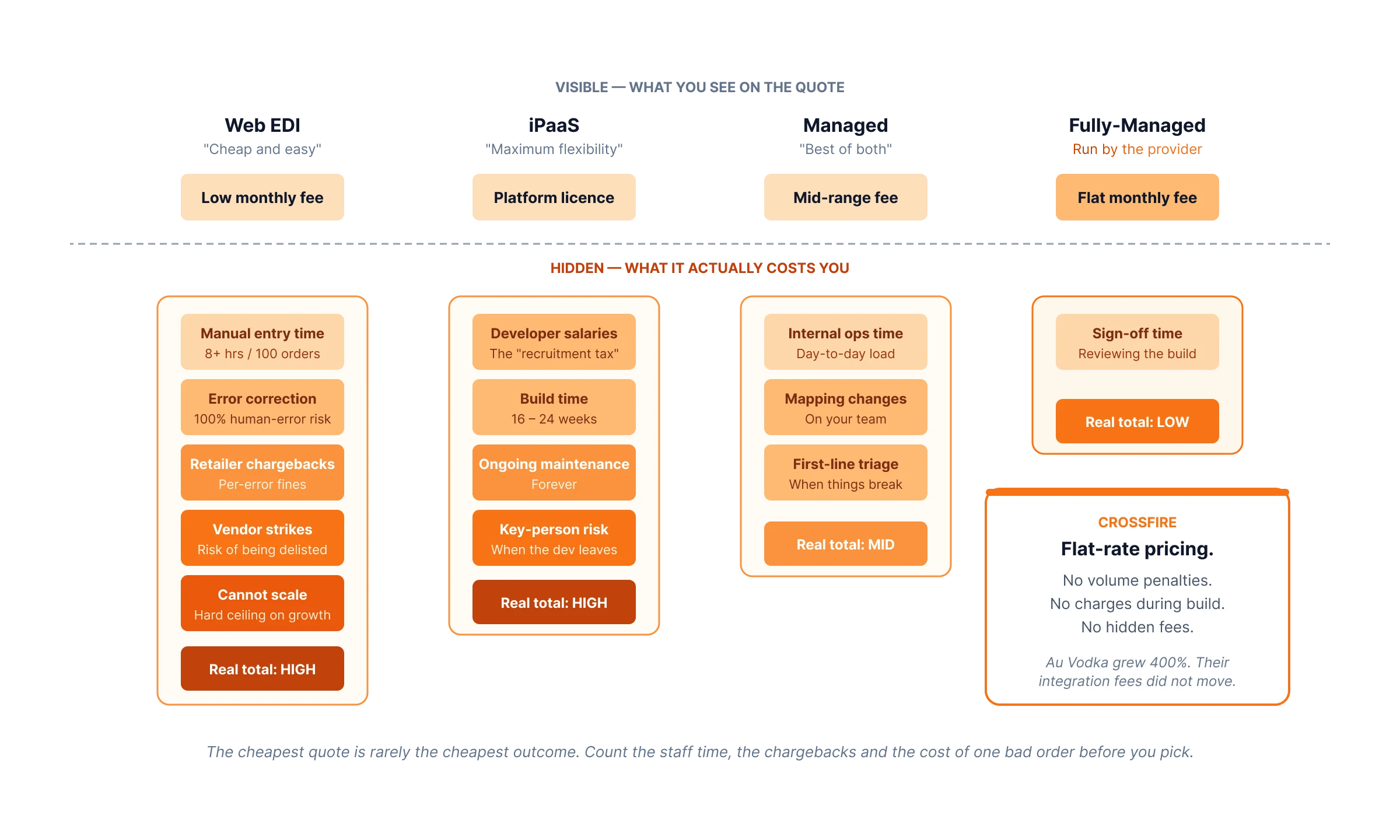
The real cost of web EDI: Processing 100 orders monthly at 5 minutes each equals over 8 hours of manual data entry per month — before accounting for error correction, missed SLAs, and chargeback handling.
Because every transaction depends entirely on manual accuracy, human error becomes a significant variable between a clean order and a retailer chargeback. A single typo in a SKU or quantity can trigger fines, "vendor strikes," and ultimately risk delisting by major retailers. When comparing monthly costs, always factor in the cost of errors — two chargebacks per month can exceed the annual cost of a fully-managed service.
Fully-managed EDI pricing
Fully-managed providers typically use a combination of three pricing structures:
Volume-based pricing: Fees scale based on data throughput or transaction counts. This effectively "taxes" your success, penalising business growth and making monthly budgeting volatile.
Per-connection pricing: Fixed fees for each active partner integration. This aligns costs directly with your supply chain network, offering transparent and predictable pricing.
Monthly subscription: A fixed monthly fee regardless of volume or partner count (within agreed scope). This model gives cost predictability and does not penalise growth.
Note: Many providers layer volume fees on top of connection costs, creating a 'double tax' on your success: you pay once to add a partner and again for every transaction you send them.
Crossfire's pricing model: Crossfire operates on a transparent one-off setup + monthly subscription structure:
Real example: Au Vodka scaled from 20 to 100 orders per day — a 400% increase — with no increase in integration fees. Under a volume-based model, that growth would have triggered a significant cost escalation.
iPaaS costs
iPaaS costs include platform licensing, hosting, internal resource costs, and ongoing maintenance. For most mid-sized businesses, total cost of ownership — once developer salaries are included — exceeds fully-managed services, whilst requiring significantly more ongoing internal effort.
Web EDI costs
Web EDI carries low software costs but high labour costs. At 100 orders per month, you are committing 8+ hours of staff time to data entry alone — before error correction or chargeback resolution. As volume grows, so does the staffing requirement, making it one of the most expensive approaches at scale despite its low headline price.
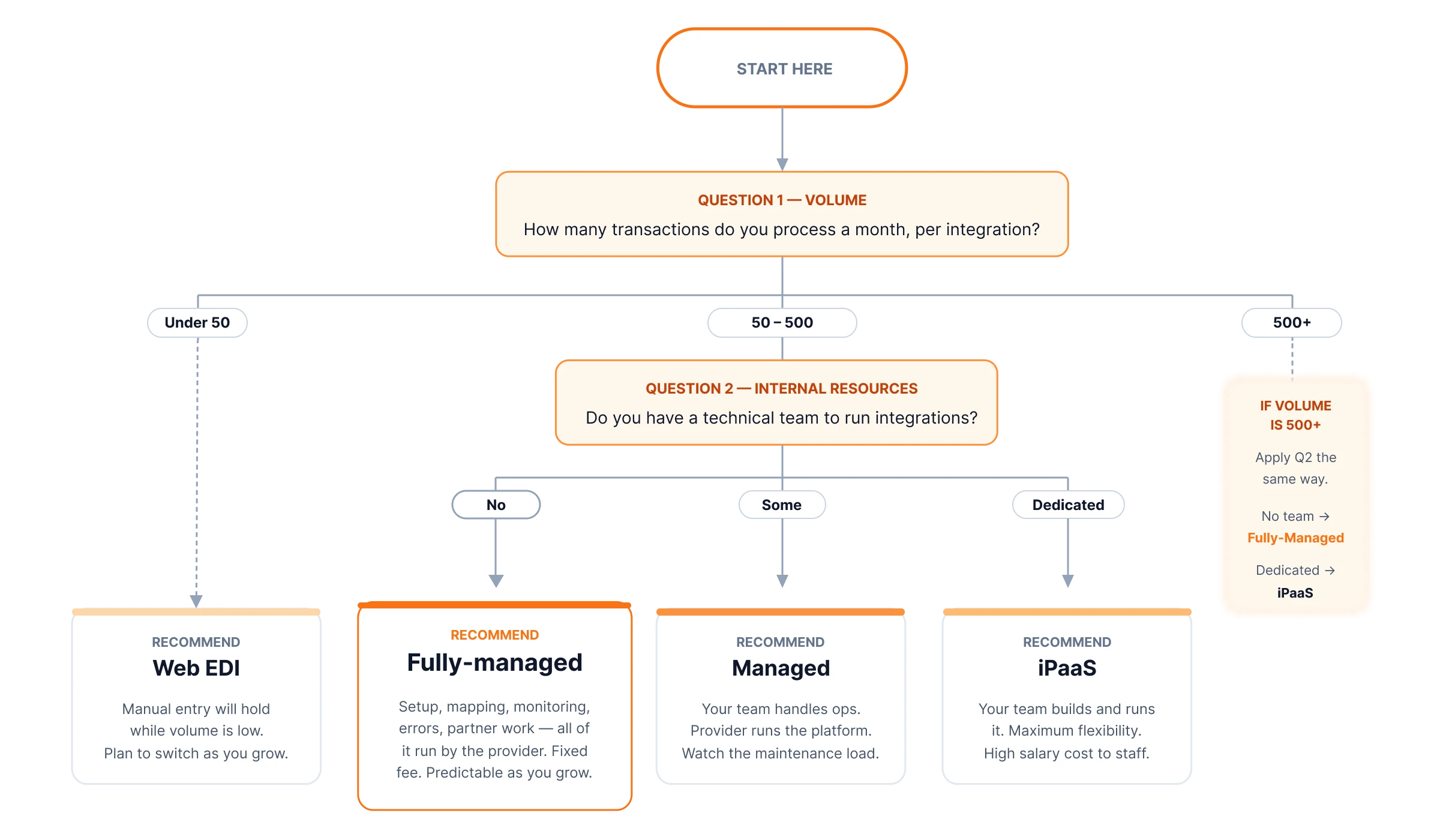
The right choice depends on three factors:
1. Transaction volume
2. Internal technical resources
3. Growth trajectory
If you are planning to scale — adding retail partners, expanding product lines, or growing order volumes — choose an approach that will not penalise that success. Volume-based and per-connection pricing models escalate as your business grows. Flat-rate fully-managed services scale without cost escalation.
Need help deciding? Use our decision guide below
Choosing based on initial cost alone
The cheapest option upfront often becomes the most expensive over time. Factor in internal staff time for ongoing management, chargeback costs from errors, the opportunity cost of delayed retailer onboarding, and how costs change as your volume grows.
Overestimating internal capabilities
Many businesses choose co-managed or iPaaS believing their team can absorb the workload — and discover too late that ongoing maintenance consumes capacity needed elsewhere. Moving to a fully-managed service with Crossfire reduced integration delivery times by 40–60% for Interlogic by removing that internal burden entirely.
Ignoring the retailer testing phase
Providers who quote short implementation timelines are often skipping proper retailer testing. A realistic fully-managed implementation includes a 3–4 week testing phase before go-live. Skipping this step is the most common cause of costly errors at launch.
Underestimating the cost of a single error
Most businesses compare monthly fees and overlook chargeback exposure. For example, at a 2% error rate on 100 orders per month, two mistakes monthly could cost more in fines and labour time to fix than a full year of a fully-managed service. Always evaluate on total cost, not subscription cost alone.
The table below breaks down the operational realities of each approach to help you evaluate total cost of ownership and required internal effort.
|
Feature |
Fully-managed |
Co-managed |
iPaaS |
Web EDI |
|
Setup |
Provider handles |
Shared |
You build it |
Minimal |
|
Technical expertise required |
None |
Moderate |
High |
None |
|
Ongoing maintenance |
Provider manages |
You manage most |
You manage all |
You manage data entry |
|
Monitoring and support |
24/7 proactive |
Basic reactive |
Self-service |
Limited |
|
Scalability |
Excellent |
Good |
Excellent |
Poor |
|
Implementation timeline |
10–12 weeks |
12–16 weeks |
16–24 weeks |
Immediate |
|
Long-term ROI |
Most cost-effective |
Stable |
High internal salary costs |
Expensive at scale |
|
Cost structure |
Fixed monthly fee |
Mid-range |
Platform fee + dev time |
Low base, high labour |
In summary: fully-managed and iPaaS both scale well, but iPaaS requires sustained internal developer resource. Co-managed works well when your team genuinely has capacity for ongoing maintenance. Web EDI is a short-term entry point, not a growth strategy.
EDI (Electronic Data Interchange) is the process of exchanging data between systems electronically, using networks. The challenge with EDI is that information needs to be translated in the centre of this process by an EDI system and should have monitoring in place to ensure bad data is caught and errored before being pushed through into another system.
New to EDI? See your potential results with our ROI calculator.
With fully-managed EDI, the provider takes responsibility for everything — setup, monitoring, maintenance, partner coordination, and ongoing updates.
With co-managed EDI, you access the provider's platform and handle most day-to-day operations yourself. The key difference is where the operational responsibility sits and how much internal time your team needs to commit.
An EDI chargeback is a financial penalty imposed by a retailer when a supplier fails to meet EDI compliance requirements. Common causes include incorrect data formats, missing documents, late transmissions, or data entry errors. Chargebacks can range from small percentage deductions to significant fines, and repeated violations can result in a supplier being placed on a "vendor strike" list or delisted entirely.
iPaaS (Integration Platform as a Service) is a broad cloud integration platform that can build EDI integrations alongside many other system connections. EDI is the data exchange standard itself; iPaaS is one technology approach for implementing it. Choosing iPaaS means your team builds and maintains EDI on the platform, rather than buying EDI as a managed service.
Yes, and many businesses do as they scale. However, starting with automation earlier reduces the accumulated cost of manual work, errors, and chargebacks. Profile Products eliminated 60–70 hours of monthly manual work by moving to a fully-managed solution.
If you're thinking of switching EDI providers, read why fully-managed integration might be the way to go.
Costs vary significantly by approach and provider pricing model. Fully-managed services on flat-rate pricing offer the most predictable costs, fixed regardless of volume. Volume-based and per-connection models escalate as you scale. iPaaS costs must include platform licensing plus internal developer time. Web EDI has the lowest software cost but the highest labour cost at any meaningful transaction volume.
Yes, and many businesses do as they scale. However, starting with automation earlier reduces the accumulated cost of manual work, errors, and chargebacks. Profile Products eliminated 60–70 hours of monthly manual work by moving to a fully-managed solution.
If you're thinking of switching EDI providers, read why fully-managed integration might be the way to go.
Small businesses processing fewer than 50 transactions per month with a single trading partner can start with web EDI as a temporary measure. However, any business expecting growth — or working with retailers who enforce strict EDI compliance — should consider fully-managed from the outset to avoid chargeback exposure and migration costs later.
Choose fully-managed EDI if:
Choose co-managed EDI if:
Choose iPaaS if:
Choose web EDI if:
Every business has different resources, growth plans, and operational priorities — which is why Crossfire offers fully-managed, co-managed and iPaas deployment approaches under one roof. Whether you need Crossfire to handle everything end-to-end, want shared access to the platform, or have an internal team that needs enterprise-grade infrastructure to build on, Crossfire can structure a service around how your business actually operates.
Get in touch to find out which EDI deployment approach is right for your business.



© Copyright 2026 Sandfield Associates Limited. All Rights Reserved. Terms of Use | Privacy Policy