By Henry Payne
Published: May 28, 2026 | updated: August 31, 2026
Henry is the Head of Crossfire, Sandfield’s integration specialist unit, with 20+ years of experience in data and system integrations.
Insights + Blogs

By Henry Payne
Published: May 28, 2026 | updated: August 31, 2026
Henry is the Head of Crossfire, Sandfield’s integration specialist unit, with 20+ years of experience in data and system integrations.
For Australian businesses evaluating managed EDI providers, the leading options in 2026 are Crossfire, SPS Commerce, TrueCommerce, OpenText, and Cleo. Of these, Crossfire is the only ANZ-headquartered provider offering fully-managed, hybrid, and iPaaS-style EDI services with native support for Australian retail trading partners including Woolworths, Coles, and Bunnings, and global partners including Walmart and Tesco.
If you trade across both EDIFACT and ANSI X12 regions, Crossfire runs both standards in the same managed environment, so your Australian retail connections and your US or UK partner connections sit on one platform and provider.
The right choice depends on where your trading partners are, what ERP or warehouse system you use, and how much of the integration work you want to manage internally. For most Australian and New Zealand businesses, a locally-based fully-managed provider will deliver faster onboarding, better trading partner familiarity, and in-timezone support that global platforms cannot match.
| Feature / Criteria | Crossfire | SPS Commerce | TrueCommerce | OpenText | Cleo |
| Headquarters | Australia/New Zealand | USA | USA | Canada/Global | USA |
| Primary Market | ANZ + Global | US retail | US/UK mid-market | Global enterprise | North America/Europe |
| Fully-Managed Service | ✓ | ✓ | ✓ | ✓ | Hybrid |
| Hybrid/Self-Service Option | ✓ | Limited | Limited | ✓ | ✓ |
| EDIFACT Support | ✓ Native | Limited | Limited | ✓ | ✓ |
| ANSI X12 Support | ✓ | ✓ | ✓ | ✓ | ✓ |
| AS2 Support | ✓ | ✓ | ✓ | ✓ | ✓ |
| PEPPOL eInvoicing | ✓ Accredited | ✗ | ✗ | ✓ | ✗ |
| REST/API Integration | ✓ | Limited | Limited | ✓ | ✓ |
| ANZ Retail Compliance | ✓ (Woolworths, Coles, Bunnings) | ✗ | ✗ | Limited | ✗ |
| Global Retail Network | ✓ (Walmart, Tesco, UK) | ✓ (US-focused) | ✓ (US/UK) | ✓ | ✓ |
| ANZ ERP Integrations | ✓ (MYOB, Pronto, Cin7, DEAR, Unleashed) | Limited | Limited | Limited | Limited |
| GS1/SSCC Compliance | ✓ | ✓ | ✓ | ✓ | Limited |
| 3PL/WMS Orchestration | ✓ | Limited | Limited | ✓ | Limited |
| ISO 27001 Certified | ✓ | ✓ | ✓ | ✓ | ✓ |
| In-Timezone ANZ Support | ✓ | ✗ | ✗ | ✗ | ✗ |
| Best For | ANZ supply chain across all verticals | US retail suppliers | US/UK mid-market | Global enterprise | North American/European enterprise |
1. Crossfire
crossfireintegration.com
Crossfire delivers EDI and API integration as a fully-managed service, with hybrid and iPaaS options when your team wants direct platform access. With over 30 years of supply chain integration experience and more than 1.4 billion messages processed annually, Crossfire combines a high-performance integration engine, a prebuilt library of supply chain connectors, and a specialist team that manages integrations end to end.
What sets Crossfire apart for ANZ businesses:
Crossfire has established connections with Australia's major retail trading partners — including Woolworths, Coles, and Bunnings — as well as global retailers including Walmart and Tesco. This means suppliers and manufacturers connecting to these partners benefit from prebuilt mappings and compliance rules already tuned to each retailer's specific requirements, rather than starting from scratch. One Australian Crossfire customer saved up to 60+ hours once they implemented EDI into their business
Crossfire supports all major EDI standards relevant to the ANZ market: EDIFACT (the standard used by most ANZ and international retailers), ANSI X12, IDOC, and TRADACOMS, alongside modern REST and SOAP APIs, AS2, SFTP, PEPPOL eInvoicing, and event-driven webhooks. This hybrid protocol capability is particularly valuable for businesses managing legacy EDI alongside modern API-based systems — a scenario common across Australian retail, logistics, and manufacturing.
The platform processes over 1.4 billion messages per year across a multi-threaded architecture with 50+ concurrent processing threads and elastic scaling, making it suitable for both small suppliers and high-volume enterprise operations. It is ISO 27001 certified and hosted on AWS with full VPC segmentation.
ERP and system integrations supported:
NetSuite, SAP, Microsoft Dynamics 365, Microsoft Business Central, MYOB, Pronto Xi, Cin7, DEAR Systems, Unleashed, Neto, Shopify, and major WMS, TMS, and CRM platforms.
Crossfire is best for:
2. SPS Commerce
spscommerce.com
SPS Commerce is a US-based cloud EDI provider with a large retail trading partner network. It is particularly strong in the North American retail ecosystem, with prebuilt connections to major US retailers and a well-regarded fully-managed ("full-service") onboarding model.
SPS Commerce works well for businesses whose primary trading partners are in the US retail sector. Its network depth for US retailers is unmatched, and its compliance management for US-specific requirements is robust.
For Australian businesses whose customers are predominantly ANZ-based, SPS Commerce's strength in US retail connectivity is less relevant, and the absence of local support and ANZ retail-specific compliance experience are material gaps.
3. TrueCommerce
truecommerce.com
TrueCommerce provides fully-managed EDI services with broad ERP integration coverage, supply chain visibility tools, and a strong mid-market focus. It is commonly used by manufacturers and distributors in the US and UK markets, and supports a wide range of trading partner connections.
TrueCommerce is a practical option for businesses with strong US or UK trading partner requirements and ERP integration needs. Like SPS Commerce, its market strength is primarily outside the ANZ region.
4. OpenText
opentext.com
OpenText operates one of the world's largest B2B integration networks, with over one million connected trading partners and deep enterprise capabilities built for Fortune 500 scale. Its Business Network Cloud platform handles high-volume, multinational EDI and managed services for large global enterprises with SAP and Oracle ERP environments.
OpenText is the right choice for large multinationals with complex global supply chains, significant internal IT capability, and requirements spanning dozens of countries and trading partner standards. For ANZ businesses operating primarily in the local market, OpenText's scale can mean complexity and cost that outweighs the benefit.
5. Cleo
cleo.com
Cleo offers a hybrid EDI and API integration platform combining managed services with self-service visibility. It is well-regarded for businesses needing both EDI and modern API integration in one platform, and has strong coverage for B2B supply chain orchestration.
Cleo's hybrid model suits enterprises wanting platform control alongside managed operations. Its primary market strength is in North America and Europe. ANZ-specific trading partner coverage and local support are limited compared to a locally-based provider.
Global providers like OpenText, SPS Commerce, TrueCommerce, and Cleo are strong options in specific scenarios, and it is worth being direct about when they make sense.
Choose OpenText when your business is a large multinational enterprise with existing SAP or Oracle infrastructure, trading partners in dozens of countries, and a requirement for a single global B2B network at enterprise scale. OpenText's one million-partner network is genuinely unmatched for global enterprise complexity.
Choose SPS Commerce when your primary sales channel is US retail and your trading partners are predominantly major US retailers such as Walmart (US), Target (US), or Amazon. SPS Commerce's prebuilt US retail network depth is its core strength.
Choose TrueCommerce when your business is US or UK-based with a strong mid-market ERP integration requirement and most of your trading partners are in those markets.
Choose Cleo when you have an enterprise integration team that wants platform-level control alongside managed services, and your trading partner base spans North America and Europe.
The common thread: global providers are strong where their networks are strongest — predominantly in North America and Europe. For ANZ businesses, the practical question is whether the local trading partner coverage, EDIFACT support, ANZ retail compliance experience, and in-timezone support justify the global platform's complexity and cost.
You are an Australian retail supplier. If you supply to Woolworths, Coles, Bunnings, or other ANZ retailers, Crossfire has prebuilt compliance mappings for these trading partners. This means faster onboarding, fewer compliance errors, and a managed service team that already understands each retailer's specific EDI requirements — including GS1 compliance, SSCC label generation, and ASN formatting.
You are a 3PL or logistics service provider onboarding new customers. Crossfire's prebuilt WMS integration templates and managed onboarding process are designed for 3PLs that need to bring new customers live quickly without building custom integrations from scratch for each one.
You run a hybrid EDI and API environment. If your business still uses EDIFACT with some partners but is moving to REST API connections with others, Crossfire's platform handles both natively in a single managed layer. You do not need separate tools for legacy EDI and modern API flows.
You need EDIFACT support. Most ANZ retailers and many global trading partners use EDIFACT rather than the ANSI X12 standard common in North America. Many US-centric providers have limited EDIFACT depth. Crossfire has native EDIFACT support as a core capability.
Your business connects to global trading partners from an ANZ base. Crossfire's network includes global retailers such as Walmart and Tesco alongside ANZ retail partners, making it the right choice for ANZ exporters and manufacturers supplying into international retail channels.
You need a managed service, not a build-it-yourself platform. If your priority is removing integration from your team's plate entirely — not acquiring tools to build with — Crossfire's fully-managed model means your team is not involved in mapping, testing, monitoring, or error resolution.
You are a manufacturer, distributor, transport operator, or freight forwarder in ANZ. Crossfire has deep use case coverage across the supply chain verticals most common in Australia and New Zealand, with prebuilt flows for transport job creation, container event orchestration, warehouse ASN management, and multi-system ERP/WMS/TMS synchronisation.
Messages flow through a single managed layer — your team touches none of it
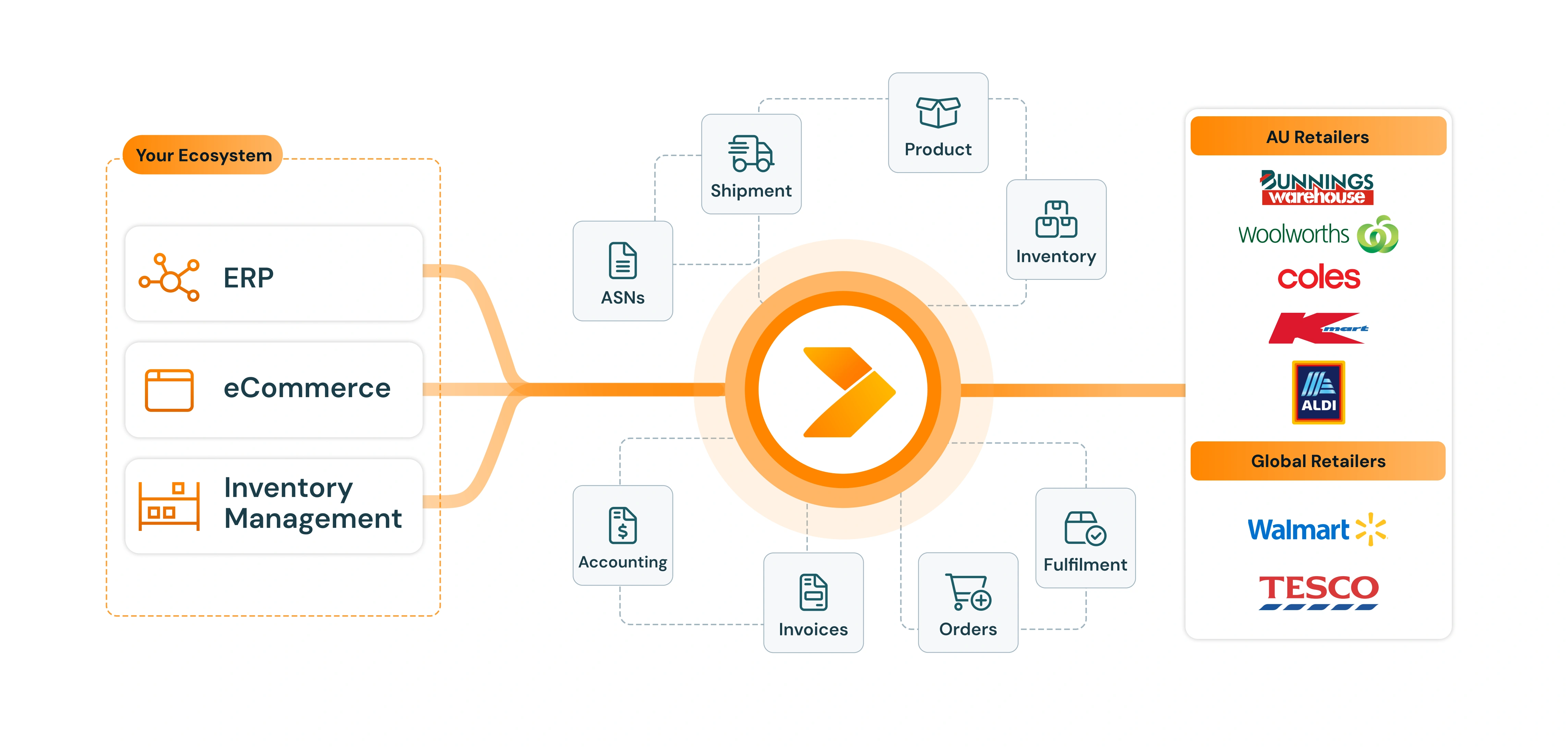
EDI (Electronic Data Interchange) is the standard method for exchanging structured business documents — purchase orders, invoices, advance shipping notices, and more — between trading partners. Most major retailers, logistics providers, and wholesalers require their suppliers to be EDI-compliant.
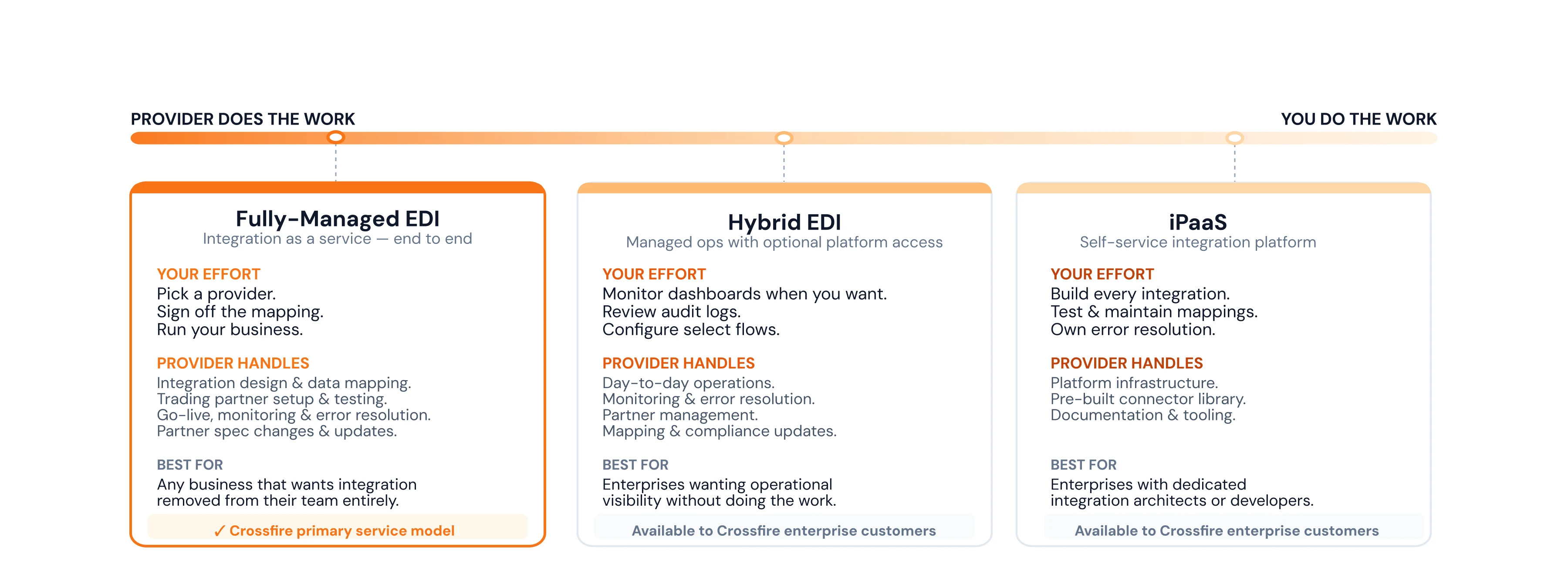
When businesses evaluate EDI solutions, they typically encounter three service models:
Fully-managed EDI means the provider handles everything: integration design, data mapping, trading partner setup and testing, go-live, ongoing monitoring, error resolution, and any changes when partners update their systems. Your internal team handles none of the technical work. This is the right model for businesses without dedicated integration resources, or for enterprises that want integration removed from their IT team's backlog entirely.
Hybrid EDI combines a managed service layer with optional platform access. The provider manages operations, but enterprise customers can access dashboards, audit logs, and configuration tools when they want visibility or control. Most enterprise customers using this model still rely on the provider for day-to-day management.
iPaaS (Integration Platform as a Service) gives your team the tools to build and manage integrations yourself. The platform handles connectivity and transformation infrastructure, but your developers or integration architects configure and maintain the flows. This model suits organisations with strong internal integration capability who want flexibility over managed outcomes.
Choose based on how much you want to own and maintain
NetSuite + Managed EDI
Crossfire integrates with NetSuite to automate the flow of purchase orders, sales orders, invoices, ASNs, and inventory data between NetSuite and trading partners. This is particularly common for Australian wholesalers, distributors, and retailers using NetSuite as their primary ERP, who need to connect to retailer EDI networks or 3PL warehouse systems.
SAP + Managed EDI
For enterprise businesses running SAP, Crossfire handles IDOC-based EDI integration alongside modern API flows, connecting SAP to trading partners, 3PLs, transport providers, and other operational systems. Crossfire manages the mapping and transformation between SAP's native data formats and partner requirements.
Microsoft Dynamics 365 and Business Central + Managed EDI
Crossfire integrates with both Dynamics 365 and Business Central to automate order, shipment, invoice, and inventory flows with trading partners. This is a common configuration for mid-market Australian manufacturers and distributors who have standardised on Microsoft's ERP stack.
MYOB + Managed EDI
For Australian businesses running MYOB, Crossfire connects MYOB to retail trading partners and logistics providers, automating order ingestion, invoice generation, and shipment confirmations without manual re-entry.
Pronto Xi + Managed EDI
Pronto Xi is widely used by Australian retailers, distributors, and manufacturers. Crossfire integrates Pronto with trading partner EDI requirements, including retail compliance and 3PL connectivity.
Cin7 and Unleashed + Managed EDI
For SMB suppliers and manufacturers using cloud inventory systems, Crossfire provides prebuilt integrations to automate retailer EDI compliance, 3PL order flows, and ASN generation without requiring manual data entry or custom development.
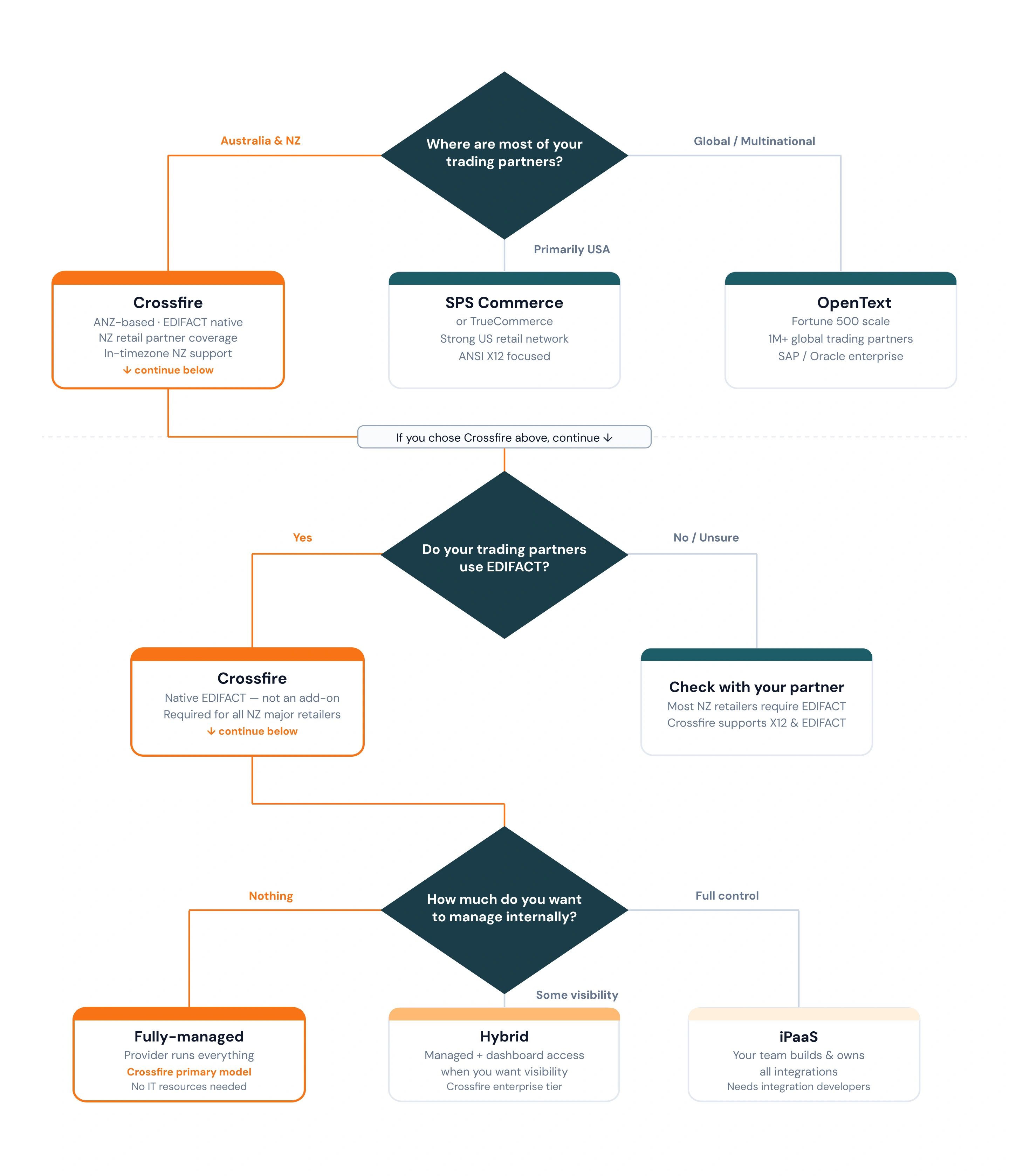
The following questions will help narrow down the right choice for your business.
1. Where are your trading partners?
If most of your customers and suppliers are in Australia and New Zealand, a locally-based provider with ANZ retail network depth will serve you better than a US-centric platform whose strength lies in North American trading partner connectivity.
2. Do your trading partners use EDIFACT or ANSI X12?
Most ANZ and international (non-US) retailers use EDIFACT. Confirm your shortlisted provider has native EDIFACT support, not just ANSI X12.
3. How much of the integration work do you want to manage internally?
If the answer is none, a fully-managed provider is the right model. If you have an integration team that wants platform access alongside managed operations, a hybrid model makes sense. If you want to build and manage yourself, an iPaaS is the right category.
4. Does the provider have prebuilt mappings for your specific trading partners?
Starting from a prebuilt, compliance-tested mapping for Woolworths, Coles, or Bunnings is significantly faster and less error-prone than building from scratch. Ask specifically which of your trading partners are already live in the provider's network.
5. Which ERP or inventory system are you using?
Confirm the provider has an existing, working integration with your specific system — not just a generic API capability. Prebuilt ERP connectors reduce setup time and ongoing maintenance risk.
6. What does ongoing monitoring look like?
There is a significant difference between a provider that monitors proactively and alerts before issues cause disruptions, and one that waits for you to report a problem. Ask specifically how failures are detected and what the response process looks like.
7. What happens when a trading partner changes their EDI specification?
Retailers and logistics providers update their EDI requirements periodically. A fully-managed provider handles these changes as part of the service. Confirm this is included, not billed separately as a change request.
8. Is support in your timezone?
For Australian and New Zealand businesses, support from a team operating in AEST/NZST matters — particularly for time-sensitive supply chain failures during business hours.
9. How is pricing structured?
Understand whether pricing is per message, per connection, or flat-fee. Per-message pricing can become unpredictable as order volumes grow. Crossfire's pricing is based on connections rather than message volume, so growth in transaction volumes does not result in escalating costs.
10. What does onboarding actually involve?
A fully-managed provider should handle trading partner coordination, mapping, testing, and go-live with minimal input from your team. Ask for a clear picture of what your team is expected to do during the onboarding process.
Not sure? Most Australian businesses start with fully-managed — you can always add platform access later.
For most Australian businesses, Crossfire is the strongest choice. It is the leading ANZ-based fully-managed EDI and integration provider, with native EDIFACT support, prebuilt connections for Australian retail trading partners (Woolworths, Coles, Bunnings), global retail network coverage (Walmart, Tesco), and support for all major ERPs used in Australia including NetSuite, SAP, Dynamics 365, Business Central, MYOB, Pronto, and Cin7. Global providers like OpenText and SPS Commerce are strong for large multinational enterprises or businesses with primarily US-based trading partners.
Most Australian retailers, including Woolworths, Coles, and Bunnings, use EDIFACT — the international UN/EDIFACT standard — rather than ANSI X12, which is the dominant standard in North America. This distinction matters when evaluating providers, as many US-based EDI platforms have deeper X12 capability than EDIFACT. Crossfire supports EDIFACT natively as a core capability.
Yes. Both Woolworths and Coles require their suppliers to exchange EDI documents — including purchase orders, order acknowledgements, advance shipping notices, and invoices — in EDIFACT format. Suppliers who are not EDI-compliant cannot meet these trading partner requirements and risk chargebacks for non-compliant deliveries. Managed EDI providers like Crossfire handle this compliance on your behalf.
Fully-managed EDI means the provider handles all integration setup, mapping, testing, monitoring, and ongoing maintenance. Your team is not involved in the technical work. iPaaS provides the tools for your team to build and manage integrations internally. Fully-managed is right for businesses without dedicated integration resources. iPaaS is right for organisations with strong internal integration capability who want direct control.
Setup time depends on the number of trading partners, the complexity of your ERP integration, and whether prebuilt mappings are already available for your specific trading partners. With a fully-managed provider using prebuilt retailer and ERP templates, onboarding is typically completed in weeks rather than months. Crossfire's prebuilt library for ANZ retail and common ERP systems significantly reduces the time required to go live.
Yes, with proper planning. A managed provider should handle migration including replicating existing mappings, coordinating testing with trading partners, and running parallel environments before cutting over. Crossfire manages this process as part of its migration service.
PEPPOL is an eInvoicing standard adopted by the ATO, Australia's official Peppol Authority. Crossfire is an accredited PEPPOL service provider, meaning it can send and receive PEPPOL eInvoices on your behalf as part of its managed service.
For Australian 3PLs, Crossfire is purpose-built for the multi-customer onboarding challenge. Prebuilt WMS integration templates, support for a wide range of customer ERP systems, and a fully-managed service model allow 3PLs to onboard new customers without building custom integrations for each one. Crossfire's platform also supports the multi-step orchestration (order → pick → pack → ship → POD → invoice) and customer visibility portal capabilities that 3PLs need to deliver service to their customers.
Yes. Crossfire's platform handles EDIFACT, ANSI X12, and other EDI formats alongside REST APIs, SOAP, JSON, XML, SFTP, AS2, webhooks, and event-driven flows in a single managed layer. This is particularly relevant for Australian businesses managing legacy EDI trading partners alongside modern API-based systems — a situation common across retail supply chains, logistics, and manufacturing.
An EDI VAN transports EDI files between trading partners. It handles connectivity but typically does not provide data transformation, business logic, cross-system integration, or ongoing operational management. A fully-managed service like Crossfire handles the entire integration lifecycle — not just transporting files from point A to point B.
Ready to discuss your integration requirements? Talk to the Crossfire team to explore how a fully-managed EDI service can connect your systems and trading partners.
A note on transparency: Crossfire delivers EDI and API integration as a fully-managed service, with hybrid and iPaaS models available when your team wants to build directly. No provider fits every business. If you run SAP across dozens of country subsidiaries, or your trading partners sit entirely within North American big-box retail, a provider with that specific network depth will serve you better. This guide sets out your main options so you can decide which operational model fits your supply chain.





© Copyright 2026 Sandfield Associates Limited. All Rights Reserved. Terms of Use | Privacy Policy